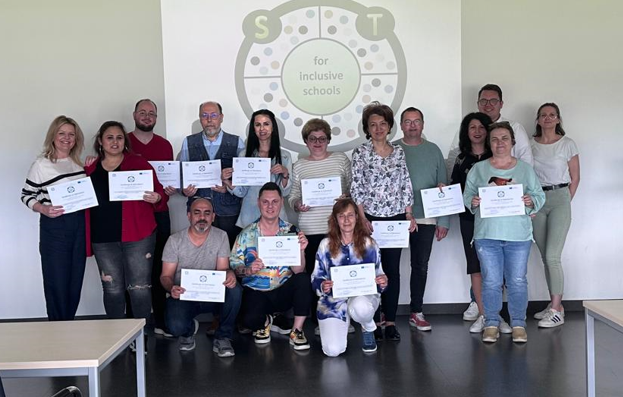
The training was hosted by the University of Paderborn (UPB) from June 3rd to June 7th, 2024. Participants from different partner organizations attended various sessions focused on inclusion, open educational resources (OER), business model canvas, and creative approaches to STEM education.
Agenda Highlights
Monday, 3rd June 2024: Arrival and Introduction
- Morning:
- Latest arrival of participants and a warm welcome from UPB representatives, including Marc Beutner.
- Introduction to the concept of inclusion in education, laying the groundwork for the week’s activities.
- Discussion on work in inclusive schools, where participants shared their experiences and challenges.
- Afternoon:
- Creative Thinking Workshop led by Helene Lindenthal. This session encouraged participants to think creatively about STEM activities and solutions for inclusive schools.
- Group activities and discussions helped participants get to know each other.
- Evening:
- A social dinner was organized to foster informal interactions and networking among participants.
Tuesday, 4th June 2024: OER and Group Work
- Morning:
- The day began with a session on Open Educational Resources (OER), led by Saskia Happ and Jan Lüttke. Participants learned about the creation, use, and sharing of OER for inclusive learning environments.
- Partners shared their experiences of using OER in their organizations.
- Afternoon:
- Group work session: Participants collaborated on designing inclusive learning strategies by creating enterprise ideas with students in schools.
- A discussion on creative ways to design learning resources, led by Helene Lindenthal.
Wednesday, 5th June 2024: Business Model Canvas
- Morning:
- The focus shifted towards entrepreneurship and financial literacy, with a session on the Business Model Canvas for STEM business ideas. Marc Beutner guided participants through the development of business models that integrate STEM learning with entrepreneurial thinking.
- Participants worked in groups to design business canvases and discuss financial aspects of the models.
- Afternoon:
- Group work continued, with teams creating posters to represent their business models. The posters were presented to the group, allowing for feedback and refinement.
Thursday, 6th June 2024: Sharing and Exploring the University
- Morning:
- Presentation and group discussions on the posters created the previous day. This session encouraged critical analysis and collaboration.
- The group had the opportunity to explore the University of Paderborn and engage with the local academic community.
- Afternoon:
- The university was closed due to a festival, giving participants a chance to relax or explore the city further.
Friday, 7th June 2024: Final Presentations and Departures
- Morning:
- Participants presented the Business Model Canvases they had developed during the week. Helene Lindenthal and Niclas Grüttner moderated the session, which concluded with a final group discussion on dissemination activities and how to move forward with project outputs.
- Afternoon:
- Final discussions on the key takeaways from the week, as well as evaluations of the workshop.
- Departure of participants.
Social and Networking Events
- A social dinner took place on Monday evening at Deutsches Haus, a restaurant in Paderborn, which provided an informal setting for participants to bond, network, and exchange ideas in a relaxed environment.
Focus of the LTTA
The week-long LTTA was designed to:
- Foster inclusion in STEM education by integrating open educational resources and innovative teaching practices.
- Promote collaboration among project partners through hands-on workshops, group discussions, and sharing of best practices.
- Encourage entrepreneurship in schools by developing business models that align with STEM education.
- Strengthen networking between partner institutions through social events and shared experiences.